High places have
always fascinated people, especially when the land has been thrust
up from an otherwise unspectacular landscape. This is the case
with the Niagara Escarpment, standing high above the relatively
flat land between the Great Lakes. As the highest place in the
area, the escarpment undoubtedly played an important role in the
stories and beliefs of the native people. Even today we wonder
how the sheer cliffs of the escarpment came to be.
Since the escarpment towers so high
above us it is tempting to think that some stupendous force within
the earth has thrust these cliffs towards the sky. As appealing
as this explanation may be, there is no evidence to support this
idea. The major break in the crust of the earth necessary for
that type of movement does not exist. The rocks underneath the
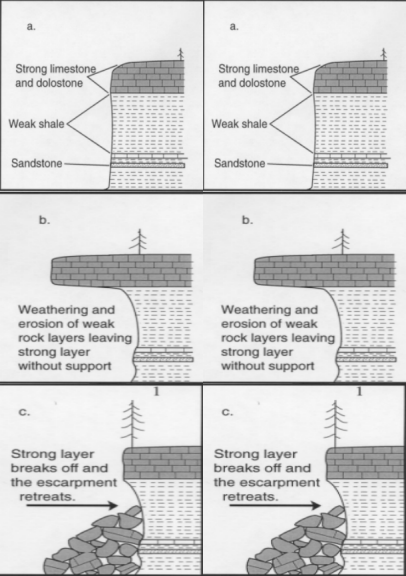
escarpment are not broken and shifted. To understand the origin
of the Niagara escarpment we must look far back into the geological
history of this area.
The story starts over 500 million
years ago. From then, until about 100 million years ago, the interior
of North America was frequently covered by shallow seas. Since
North America was located further south for most of this time,
the environment was quite tropical and animals like corals and
other shelled organisms thrived in these seas. When they died
their shells and skeletons accumulated as thick layers of sediment
made mostly of mineral calcite (calcium carbonate). During some
periods, large amounts of sand and clay sediments were washed
off the land and accumulated as layers in the sea. Over time a
layer cake-like accumulation of flat-lying layers of sediment
built up, compacted, recrystallized and turned to stone.